The impending death of Stack Overflow?
It has been nearly two years since my last post on this blog! I’m not sure if anyone even reads this; I mainly keep up this site as a convenient place to host some of my own tools ad-free.
I started to write an entirely different version of this post, but in doing a little research about it, I found this graph of Stack Overflow activity that absolutely blows my mind:
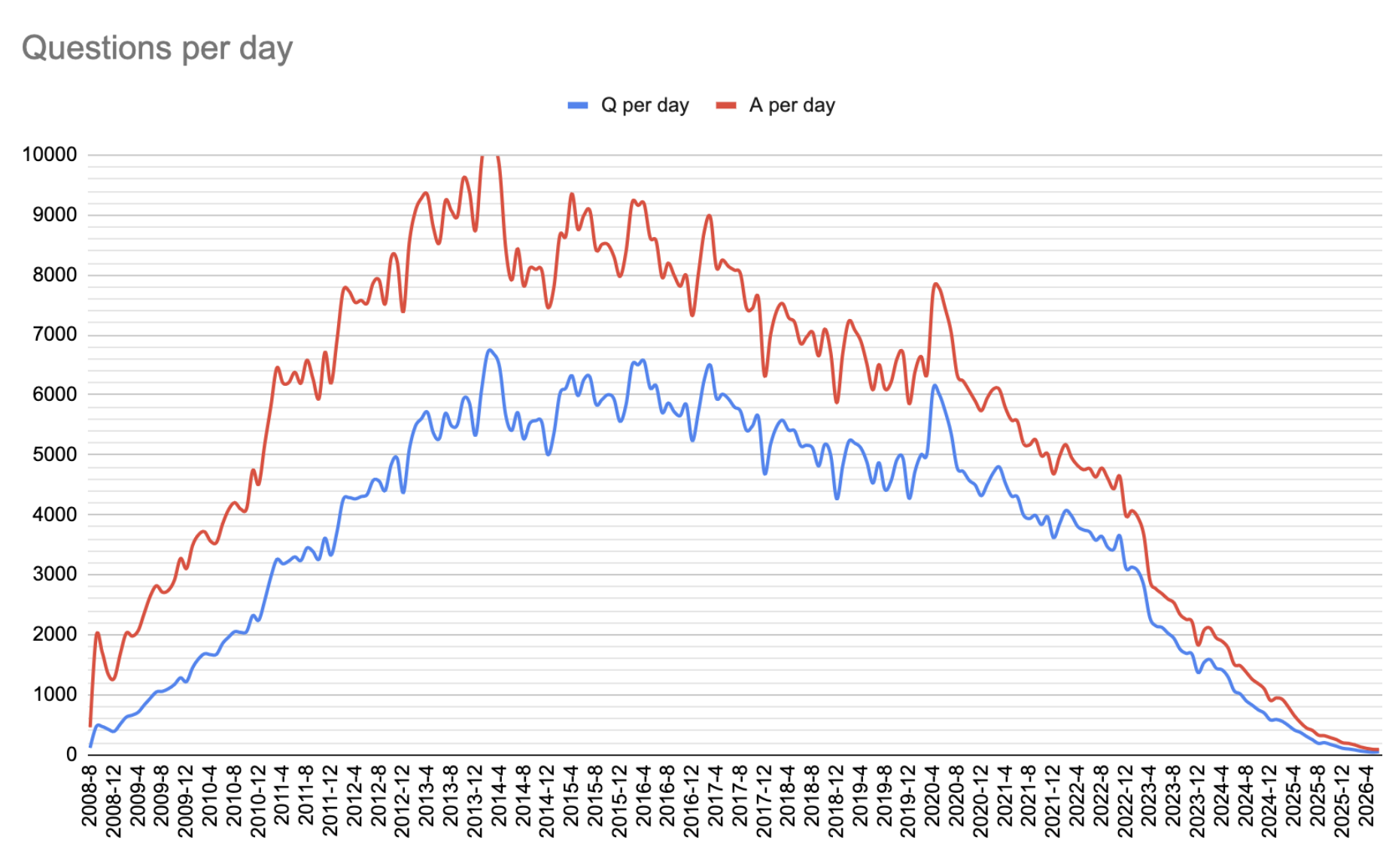
It looks like AI has effectively killed Stack Overflow. But I don’t think that’s the whole story.
Let me rewind a bit: Before Stack Overflow existed, I was already following Joel Spolsky, who would be a co-creator of the site. So I was there when the site was founded in 20081 (member since September 19, 2008!). The company made a promise at the beginning that all content submitted to the site would be under a creative commons license. Stack Overflow would be a host of the content, but it belonged to the world. You could, quite legally, create your own replica of the entirety of Stack Overflow’s content, and the company provided monthly (now quarterly) data dumps. Why did they give away all their data, you may be asking? It was a promise that they could never be bought by another company who would put the data behind a paywall—legally, the acquiring company wouldn’t own the historical data, and even if they tried to hide it behind a paywall, anyone with the data dump could start up a new fork of the site2.
It was a poison pill against enshittification, fourteen years before Cory Doctorow coined the term.
A promise to any users who devoted their time to the site, with no reward other than fake internet points, that their efforts wouldn’t be taken away to make someone else a billionaire.
But this data dump must have been a godsend to companies building large language models. It contains over a decade’s worth of real human Q&A content, in markdown format, with the good and bad answers already categorized by humans. You can’t ask for better training data.
So why do I think “AI killed Stack Overflow” is not the whole story? The site had a big problem, from the very beginning: the very active human experts would get tired of answering bad/lazy/repeat questions, which made them very hostile to new users. The company tried to address this in various ways, but never really solved the hostility problem. Most active users on the site tried to justify the behavior, like I did on this blog in 2015.
Fast-forward to 2022, my very first impression when asking an AI a programming question was: “It’s like Stack Overflow, but it doesn’t get mad at you if you ask a bad question!” I think a lot of people had that experience. Looking at the chart from the top of this post, Stack Overflow was already on a pretty steady decline from about 2017-2022. The arrival of AI in 2022 definitely accelerated this, but I think never resolving the Original Sin of being a toxic community was already dooming the site. It’s actually quite telling that the post I pulled that chart from, Stack Overflow is becoming a ghost town. Now what?, is currently sitting at -10 points. They’re still hostile!
Would the site have survived if it was still doing 2013 numbers when AI came out? It’s impossible to know, but I kind of think so. Reddit is also a Q&A site and it seems to be holding up. It was once extremely toxic, and I’m sure many subreddits still are, but my understanding is that they made real efforts to make the site more welcoming.
Disclaimer: I have only posted on Reddit maybe twice, in an anonymous account, so maybe I’m off-base here? I definitely find that if I google something (whether programming related or not), after scrolling past the AI slop overview, the best answers are either Reddit threads or Wikipedia articles. Sometimes I’ll append reddit to the end of a search query just to get what I want faster. They are definitely doing something right that Stack Overflow never figured out.